
Air Filtration for Your Home
What filter should you buy? Start with what fits your home, then compare how well it captures particles and lets air through.
The Short Answer
A filter that fits.
Capture your system can handle.
Start with the correct size and cabinet fit. For finer particles, EPA recommends MERV 13, or as high as your system can accommodate.
Don’t shop by MERV alone. The filter also needs to let your heating and cooling system move enough air. Check your equipment’s requirements before changing filter type.
Find Your Starting PointWhat’s in Your Home?
Choose the setup that looks familiar.
I have a thin, 1-inch filterA flat, framed filter in a narrow slot or return vent.
Match all three dimensions and check the actual size, not just the rounded size on the box. Look for a pleated filter that fits snugly without bending. Choose the capture rating and resistance together, within your equipment’s requirements.
Identify My FilterI have a thicker filterA deep filter in a rack or cabinet.
Check whether you need a standard framed filter or replacement media made for a specific cabinet. Two filters marked “16 × 25 × 4” can have different actual dimensions. Depth alone doesn’t prove fit, lower resistance or longer life.
Compare Filter TypesI have an AprilAire cabinetA cabinet with a model number and fitted rails.
Find the cabinet model and the part number on your current filter. Check the installed rails too: original media, a conversion kit and later refill media can be different purchase paths. A matching size on the box is not enough.
Check Cabinet & Rail OptionsI’m not sure, or I want an upgradeStart with a photo of the filter and its opening.
Photograph the old filter label, cabinet label and the whole filter opening. Check your equipment manual. Our office can help identify the next step; airflow concerns may need an HVAC technician’s measurements.
Ask Our OfficeFive Checks Before You Buy
Get to Know Your Filter’s FACES.
A quick way to compare filters. Open any check for more.
FitAir through the filter, not around it.
Match actual dimensions, cabinet and rails. The filter should fit snugly, without gaps or crushing it into place.
AirflowMERV is not an airflow rating.
Compare published pressure drop at the same airflow, size and configuration. Your equipment and ductwork set the limits; an HVAC technician can check them.
CaptureChoose for the particles you want to catch.
MERV describes tested particle capture. Higher capture can help with finer particles when the system can support the filter. A normal particle filter doesn’t remove every pollutant or gas.
EnduranceYour home affects how quickly it fills up.
Dust, smoke and system runtime change loading. Follow the exact filter’s instructions and inspect regularly. More media area or lower initial resistance doesn’t prove a longer replacement interval.
SpendingCompare the cost per filter, not per box.
Check pack quantity, shipping and tax, then consider how often you actually replace it. Keep any cabinet or conversion-kit cost separate.
FACES comes from Better Air Filter Finder. It’s a comparison guide, not a certification or product score.
What Our Filter-Label Research Shows
A higher MERV number does not automatically mean more resistance. In Filter Finder’s photographed group of eleven nominal 16 × 25 × 1 Filtrete MERV 5–14 records, MPR 1900 / MERV 13 had the lowest printed initial resistance at all five shared airflow points.
That group excludes the lower-resistance MERV 1 and disputed MPR 1550. Actual dimensions vary and matching test conditions are incomplete. These are package claims, not our lab tests or a recommendation for every home or size.
Filtration Upgrades
Need More Than a Replacement Filter?
Better Air Northwest installs complete AprilAire media cabinets, replaces suitable existing cabinets and installs compatible rail or upgrade kits. We also handle basic duct modifications; additional ductwork needs an individual assessment.
We’ll review your cabinet model, room for installation and system requirements before recommending an option. Not every rack accepts a conversion kit.
Ask About Your Filtration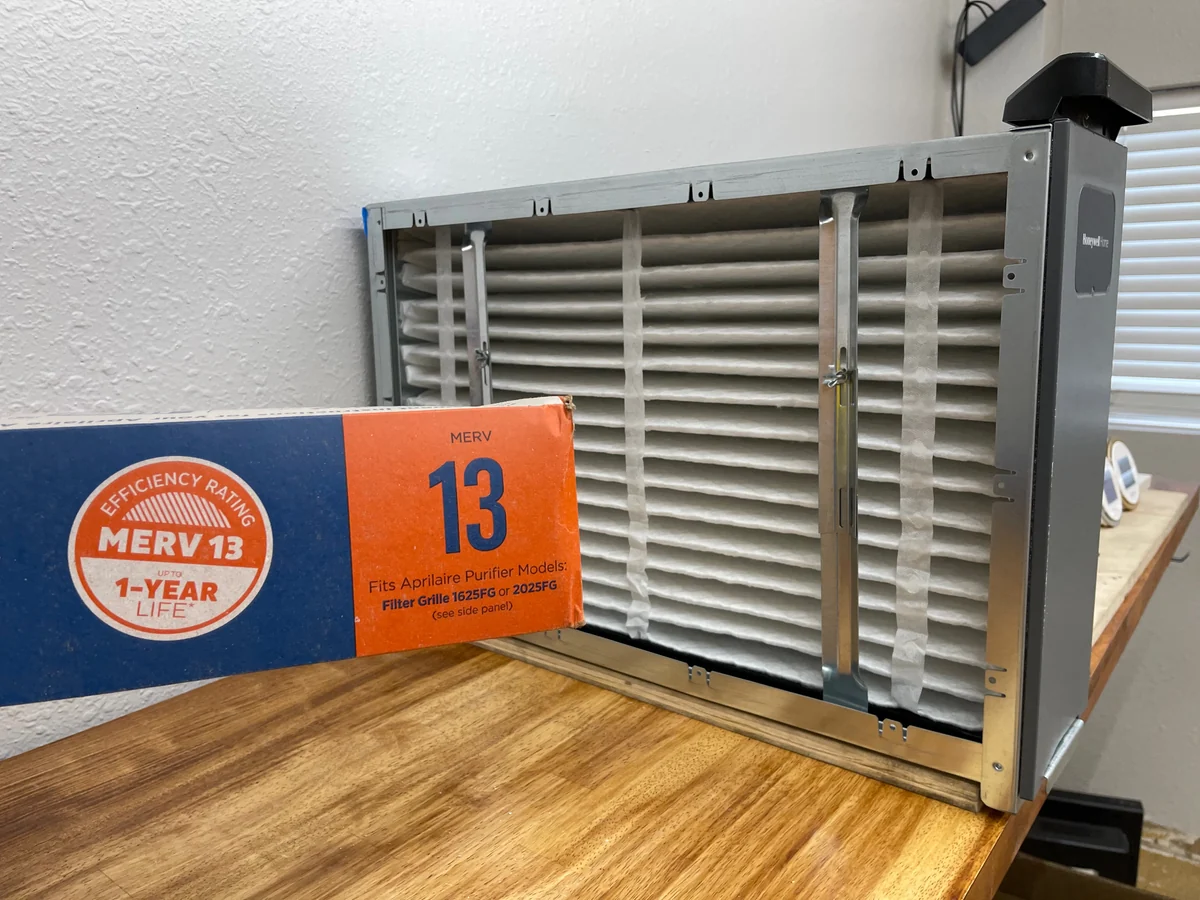
Common Filter Questions
Is MERV 13 too restrictive?
Not automatically. MERV measures particle capture, not resistance. Two filters with the same MERV can have different pressure drops. Check the exact filter at the relevant airflow and what your equipment can support.
How often should I change my filter?
Follow the instructions for the exact filter and inspect it regularly. Dust, smoke, pets and heating or cooling use can change how quickly it loads. A fixed monthly or yearly rule won’t suit every home.
Will a thicker filter fit my existing slot?
Only if the rack or cabinet is designed for it. Don’t force a deeper filter into a thin slot, stack filters, or assume a cabinet can accept a conversion kit because the size sounds right.
Still unsure? Have your filter label and cabinet model handy. Our office can help you choose the next step.